
St. Lucie Previous-Resident Sources
Previous residents appear in overlapping records, not one continuous register. The current parcel card supplies the starting owner, site address, parcel ID, legal description, and transfer references. Deeds then identify parties to each transfer. Printed directories and census schedules add household evidence for selected years, while a Fort Pierce fire-insurance map fixes a building in a particular month.
| Source | Years It Covers | Where Held | What It Shows |
|---|---|---|---|
| Official Records | 1980-present | Acclaim | Recorded instruments, parties, and images |
| Historical deeds | 1953-1960 verified online | Historical Deeds / Clerk | Deed parties and book references |
| Gap interval | 1960-1979 | Clerk request or counter | Books and index not yet presented as continuous web coverage |
| City directories | 1916, 1918, 1920-23, 1927-28, 1931 | NARA and libraries | Names, occupations, and address snapshots |
| Federal census | Public schedules through 1950 | NARA and library databases | Household members at ten-year anchors |
| Sanborn map | May 1924 | Library of Congress | Fort Pierce building form and street context |
| Permits and probate | Coverage varies | City, county, Clerk | Building work, estates, heirs, and dates |
The date bands matter. A blank portal result can mean a staged collection, a skipped directory year, or a record held at the counter. It does not establish that nobody lived at the address.
Build a dated evidence log from the start. Record the source, the date it describes, the date it was created, the exact name form, and the address or legal description shown. A deed may be recorded after signing, while a directory canvass may occur before the year on its cover. Keeping those dates separate prevents a false move-in or move-out claim.
Start With St. Lucie Resident Records
Use the St. Lucie County Property Appraiser search before guessing a past resident's name. Search the site address, then save the parcel ID, legal description, current owner, separate owner mailing address, and the sale or transfer book and page. The situs address means the physical place. A mailing address only shows where the owner receives tax correspondence.
The record card can also expose grantor and grantee names, sale dates, and links to a map or detailed report. Those fields point toward the deed index. They do not prove that the owner lived there. A renter, relative, or other household member may never appear on the tax roll.
Keep the land constant. Copy the parcel ID and legal description at the start; they are safer guides than an old street label.
Three St. Lucie Previous-Resident Eras
The Clerk's online history is useful but not seamless. Acclaim Official Records covers 1980 forward. The Clerk announces a 1905-1960 historical deed project, yet the live navigation inspected in August 2026 showed 1953-1960 as available while 1905-1953 remained marked “Coming Soon.” The 1960-1979 interval is separate.
For the web gap, use the Clerk Research Department request, call 772-462-6930, mail P.O. Box 700, Fort Pierce, FL 34954, or visit the recording counter at 201 S. Indian River Drive, fourth floor, weekdays 8 a.m. to 5 p.m. The research form states a normal two-to-seven-business-day range and quotes cost before work. The counter and request route are part of the search, not last-resort trivia.
Note: Confirm the exact historical volume with the Clerk before travel because the digitization project remains staged.
Trace St. Lucie Previous Residents Backward
A chain of title is the sequence of recorded transfers for the same land. Start with the newest deed and move back one transfer at a time. Names can change in spelling or form, so the legal description provides continuity.
- Open the current parcel card and record its transfer reference and legal description.
- Find the purchase deed in Acclaim, using name, book and page, or instrument number.
- Read the seller, called the grantor, then search that person earlier as a grantee, the buyer.
- Compare the legal description at each step and repeat the grantor-to-earlier-grantee search.
- When online coverage ends, request the relevant index or deed book from the Clerk.
- Grantor and grantee
- The grantor transfers an interest; the grantee receives it.
- Chain of title
- The linked sequence of transfers for the same parcel.
- Legal description
- The lot-and-block or metes-and-bounds description identifying land apart from its mail address.
A deed identifies transaction parties. It is not a roll of every previous resident. Pair the chain with sources made to list households.
Acclaim offers Name, Book/Page, Instrument Number, and Simple Search modes. A known transfer reference is often the cleanest route. When searching a name, try initials, compound surnames, and ordering variants, then confirm the parcel description before joining two records. Registration can add date-range tools, but guest searching is free. Images and certified copies may involve separate charges.
St. Lucie Previous Residents Between Censuses
The verified Fort Pierce directory run is sparse but precise: 1916, 1918, 1920 through 1923, 1927 through 1928, and 1931. NARA lists those volumes, and regional library bibliographies add a 1916 Fort Pierce City Directory and St. Lucie County Gazetteer plus a 1918 county directory. The St. Lucie County city directory collections deserve a separate shelf-level search.
To trace past residents, place directory findings beside the 1920, 1930, 1940, and 1950 federal censuses. Census schedules open after 72 years. A directory canvass may predate its imprint year, and an omitted year may never have been published. Search initials, surname fragments, and spelling variants.
- Choose the directory year closest to a known deed or census date.
- Copy the entry exactly, including spouse, occupation, address, and widow notation.
- Compare the prior and next available volume.
- Check the nearest open census for the full household.
- Return to deeds to separate the listed occupant from the legal owner.
Verified St. Lucie Directory Years
The National Archives city-directory holdings list documents the Fort Pierce years used in a previous-residents search.
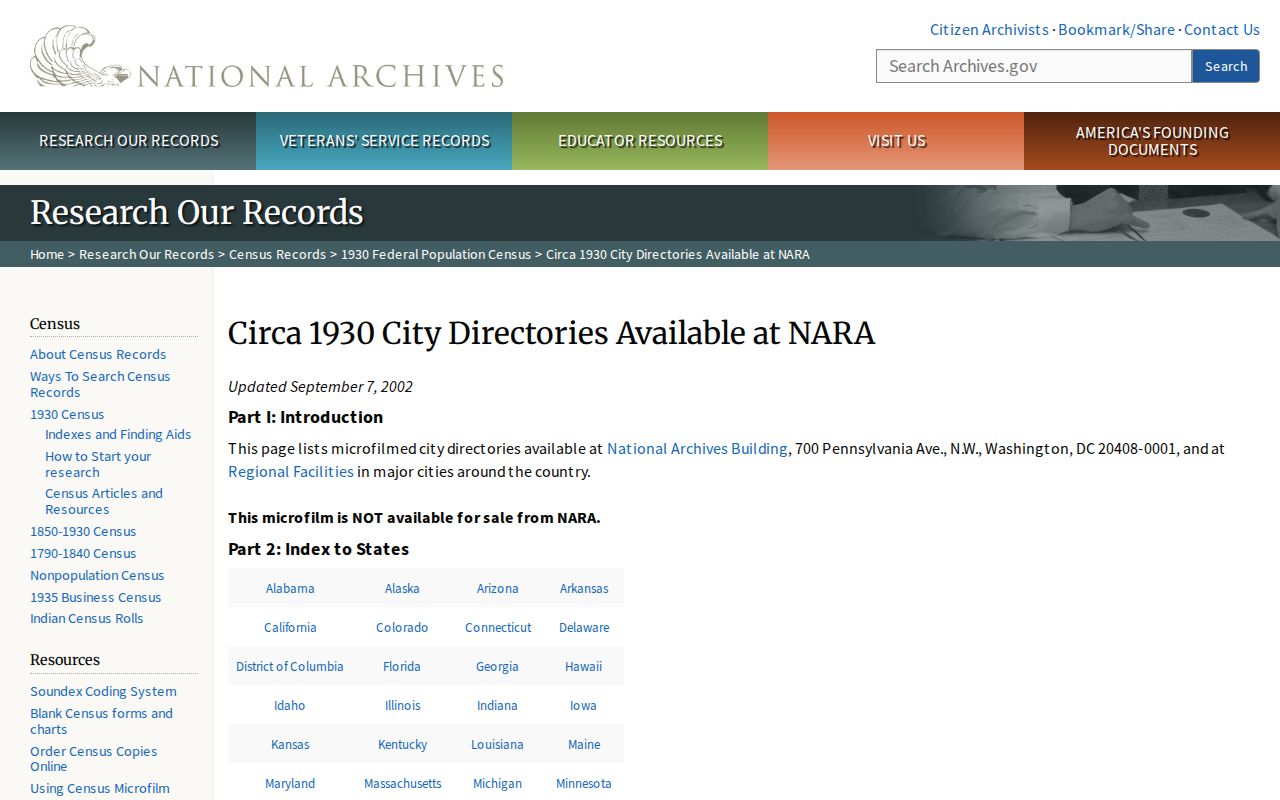
The captured holdings page is evidence of an uneven run. Treat each listed volume as a dated household snapshot, not proof of annual coverage.
Map 1924 St. Lucie Resident Records
Fort Pierce has a rare three-part match around 1924. The Library of Congress gallery holds ten Sanborn sheets from May 1924. A 1923 or 1927 directory can supply a surveyed occupant, the map supplies the building footprint, and a deed can identify the legal owner.
Sanborn sheets show built form, street context, and construction details. They do not name every previous resident. When a street number fails, compare the map location with the subdivision, lot, block, and parcel evidence instead of inventing a countywide renumbering event. No authoritative St. Lucie County street-renumbering year was found.
Note: The verified Sanborn evidence is Fort Pierce in May 1924, not a countywide map run.
St. Lucie Previous Residents in Estates
Permits can date a roof, addition, demolition, or other change. They cannot prove occupancy. Choose the custodian by municipal boundary, not the postal city printed on an envelope. Port St. Lucie, Fort Pierce, and unincorporated county addresses use different permit offices, and Port St. Lucie results may show separate current and Legacy address rows.
For unincorporated land, begin with county permitting and zoning. Search both current and older address forms where the portal permits. An unverified archive start year means the office or a public-record request may be needed for older work.
Probate files and obituaries can close a household trail after death or a move. Search the Clerk by party name, then ask the Clerk or library when an image is restricted or an obituary index is not online. Exact local newspaper coverage years were not verified, so do not assume a complete digital run.
The St. Lucie County Library genealogy service adds two paths. Ancestry Library Edition works inside branches, while HeritageQuest is remote with library credentials. Call 772-462-1618 to ask which newspapers or yearbooks are currently licensed. The Regional History Center and St. Lucie Historical Society can add photographs and local context, though no complete online name index or research fee schedule was verified.
Previous Residents Before St. Lucie County
Modern St. Lucie County took effect in 1905 from southern Brevard County. Its first boundary also included land later placed in Indian River, Okeechobee, and northern Martin counties. A present-day county label can therefore misroute an early deed search.
When the chain crosses 1905, follow the record date and historic county. Search pre-1905 books in Brevard while holding the parcel's old legal description and nearby names constant. Later boundary changes require the same care. This geography is why an Indian River library bibliography can matter to northern St. Lucie family history.
Use St. Lucie Previous-Resident Evidence
Ownership, occupancy, and kinship are separate claims. Require two independent matches before naming past residents: for example, the same address and spouse in a directory plus a census household, or a deed party plus a probate file tied to the same legal description. Mark dates and uncertainty in research notes.
Florida records can shield protected addresses and restricted probate or vital details. Do not reconstruct suppressed fields from another source. House history, genealogy, estate research, and personal curiosity are sound uses; tracking or intimidating a living person is not.
Lawful use. Florida law prohibits stalking and cyberstalking. Respect protected records and never use previous-resident findings to harass, threaten, or follow anyone.