
Finding St. Lucie County Residents
Start with the detail that is least likely to be shared by two people. A full street address belongs in the St. Lucie County Property Appraiser search. A person's name can be checked in the Clerk's recorded-document index and local court search. An older name or address may fit a city directory, census schedule, newspaper, or map better than a current database. Each source answers a narrow question. The property roll identifies an owner, not every person at the home. A deed records a transaction, while a voter entry reflects registration subject to Florida's disclosure limits.
The most reliable St. Lucie County residents directory search compares two independent records. Note dates, middle initials, mailing addresses, parcel numbers, and book-and-page references. Those details separate similar names and show whether a result is current or historical. Renters and other household members may never appear on an ownership roll, and protected records will not appear in a public search.
- Search the county property roll by owner, situs address, or parcel ID.
- Use the Clerk's name index for deeds, liens, marriages, and other recorded instruments.
- Check the local court party search when a case is relevant.
- Move to library and archive collections for an older household.
- Ask the proper custodian for records that are held offline or withheld from the web.
St. Lucie Resident Record Keepers
Three county offices supply the main current resident rolls. The Property Appraiser links owners, situs addresses, mailing addresses, parcel identity, values, sales, and maps. The Clerk of the Circuit Court and Comptroller records deeds, mortgages, liens, judgments, plats, marriage licenses, and other instruments. The Supervisor of Elections manages registration and the lawful release of voter data. City permit records remain with Port St. Lucie or Fort Pierce when the parcel lies inside those cities, while county Planning and Development principally serves unincorporated land.
Clerk Recording Department
201 S. Indian River Drive
Fort Pierce, FL 34950
772-462-6900
Clerk Research Department
201 S. Indian River Drive, 4th Floor
Fort Pierce, FL 34950
772-462-6900
Both the Fort Pierce Courthouse and South County Annex serve the public on weekdays. Confirm hours before travel. The Clerk's research form is especially useful when an image is confidential online, an older interval is not indexed on the public portal, or only a certified copy will meet the reader's need.
St. Lucie Property Directory Clues
The Property Appraiser is the best address-first entrance to the St. Lucie County residents directory. Search by owner name, street address, parcel ID, or map. The report distinguishes the situs address, where the parcel is located, from the owner's mailing address. That difference matters. An out-of-county mailing address can suggest an absentee owner, but it does not prove who occupies the home. Parcel reports also expose legal descriptions, value history, exemptions, transfer references, and links to the Tax Collector.
The map can confirm municipal boundaries and reveal adjacent parcels. That solves a common local problem: a Fort Pierce or Port St. Lucie postal line does not always identify the government that holds permit and code records. Follow a parcel's jurisdiction before opening a city or county permit system.
The Property Appraiser home screen shows the official route into the owner and address search.
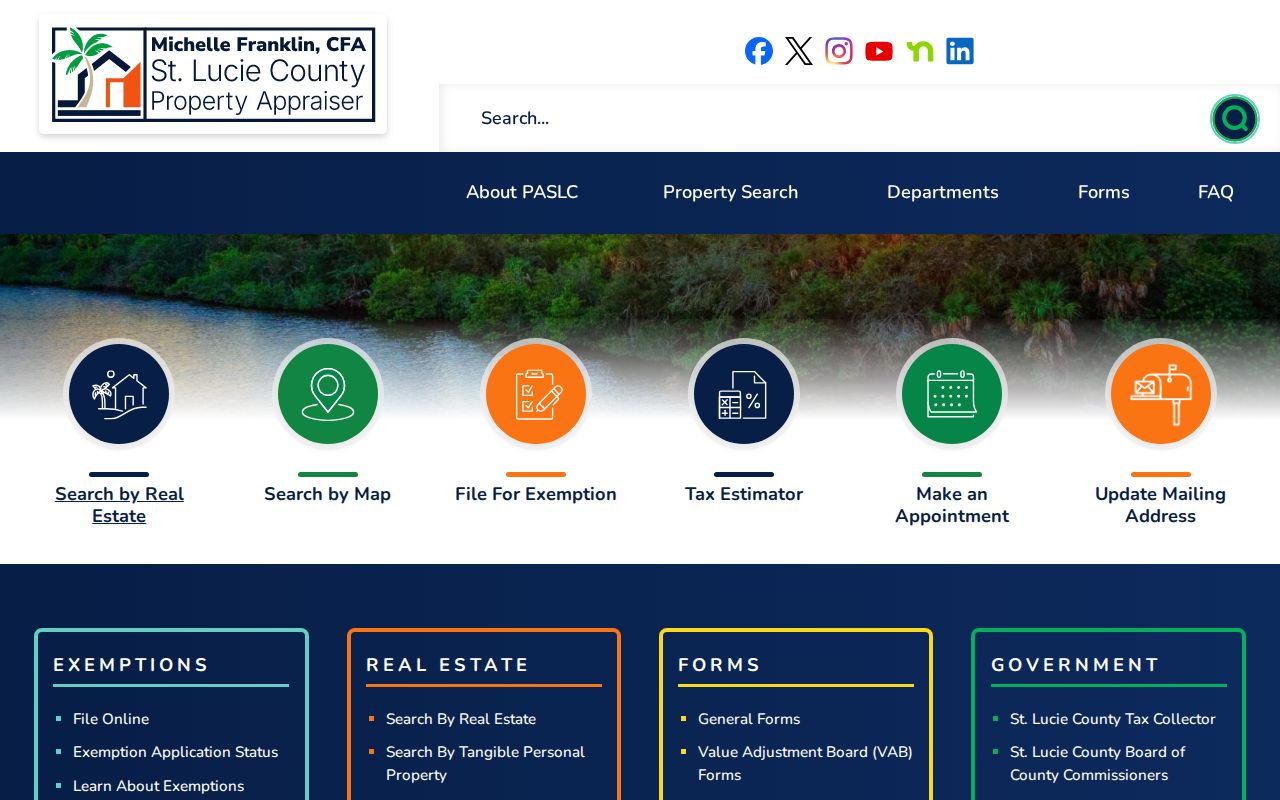
Use the parcel identity from that result as the stable link to maps, taxes, sales, and recorded deeds.
Acclaim Names St. Lucie Residents
Acclaim Official Records indexes instruments from 1980 forward. Its Name, Book/Page, Instrument Number, and Simple Search modes let a reader move between a person and a specific filing. Name searches should include spelling variants, married names, and initials. A result may identify indexed parties and roles, instrument number, document type, recording date, book and page, legal description, and an image when web display is lawful.
| Search control | Best use | Format note |
|---|---|---|
| Name | Find deeds, liens, and other party records | Try Last, First and variants |
| Book/Page | Open a cited recorded instrument | Use both parts of the citation |
| Instrument number | Retrieve one known filing | Enter the recorded identifier |
| Date range | Narrow a common name | Registered access adds features |
The index is free for guests, but copies and certification may cost money. A standard copy is listed at $1 per page and certification at $2 per document. Confidential or archive material requires a request. The portal screen below makes the distinction between searching an index and ordering an official copy clear.
Open the Clerk's official-record search before choosing a mode.
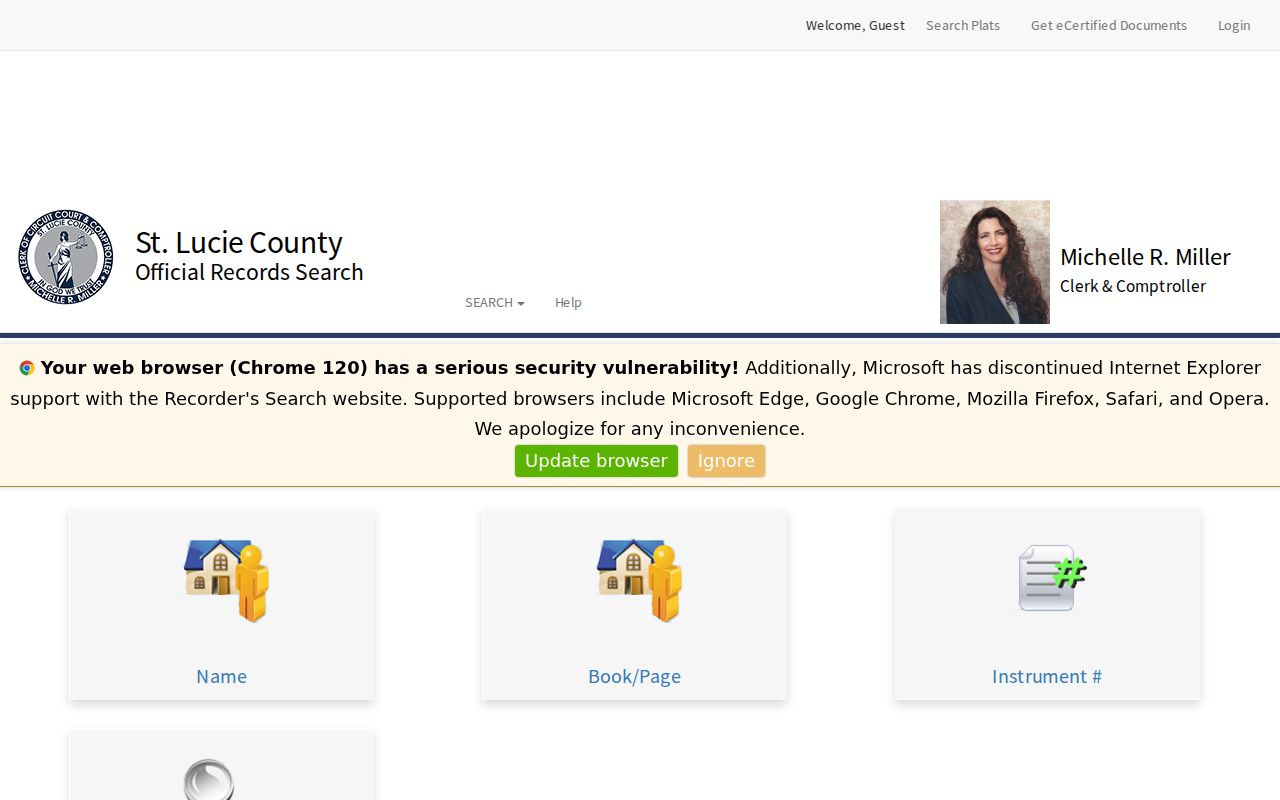
The tabs support either a broad resident name search or a direct citation lookup.
Current St. Lucie Resident Rolls
A current directory is a set of separate official rolls, not a master list. Pick the roll by the fact it was created to document. Property and deeds work well for ownership. Court files establish litigation events, not an everyday address book. Voter data follows Florida's public-record rules, and protected voters may be suppressed. License and corporate filings can confirm a public business or professional link, but they do not establish where a person now lives.
| Official source | What it can confirm | Custodian | Public route |
|---|---|---|---|
| Parcel roll | Owner, situs, mailing address, sales | Property Appraiser | Free search and map |
| Recorded instruments | Named parties, filing date, legal description | County Clerk | Free index; paid copies |
| Voter information | Registration fields allowed by law | Elections offices | Personal lookup or state extract |
| Court case index | Party, case type, status, docket | County Clerk | Selected public cases |
| License records | Name, credential, status, location | Florida DBPR or MQA | Free verification |
Use records lawfully. Public access does not permit stalking, harassment, threats, fraud, or attempts to defeat a protected address.
St. Lucie Court Party Lookup
The Clerk Court Case Search accepts a name, case number, citation number, opened or closed date range, court type, and cause of action. A search also requires an arithmetic CAPTCHA. Results can show party roles, case status, events, charges, citations, bonds, and docket entries. Some document images require a free account, while sealed, expunged, juvenile, mental-health, and other confidential material is not available like an ordinary public resident roll.
Selected public cases and documents generally reach back to 2008 under the Clerk's media guidance. If the web record is incomplete, provide the case number or party details through the Clerk Research request. The stated normal completion range is two to seven business days, with a cost quote before work.
Use the local Circuit and County Court portal for St. Lucie cases.
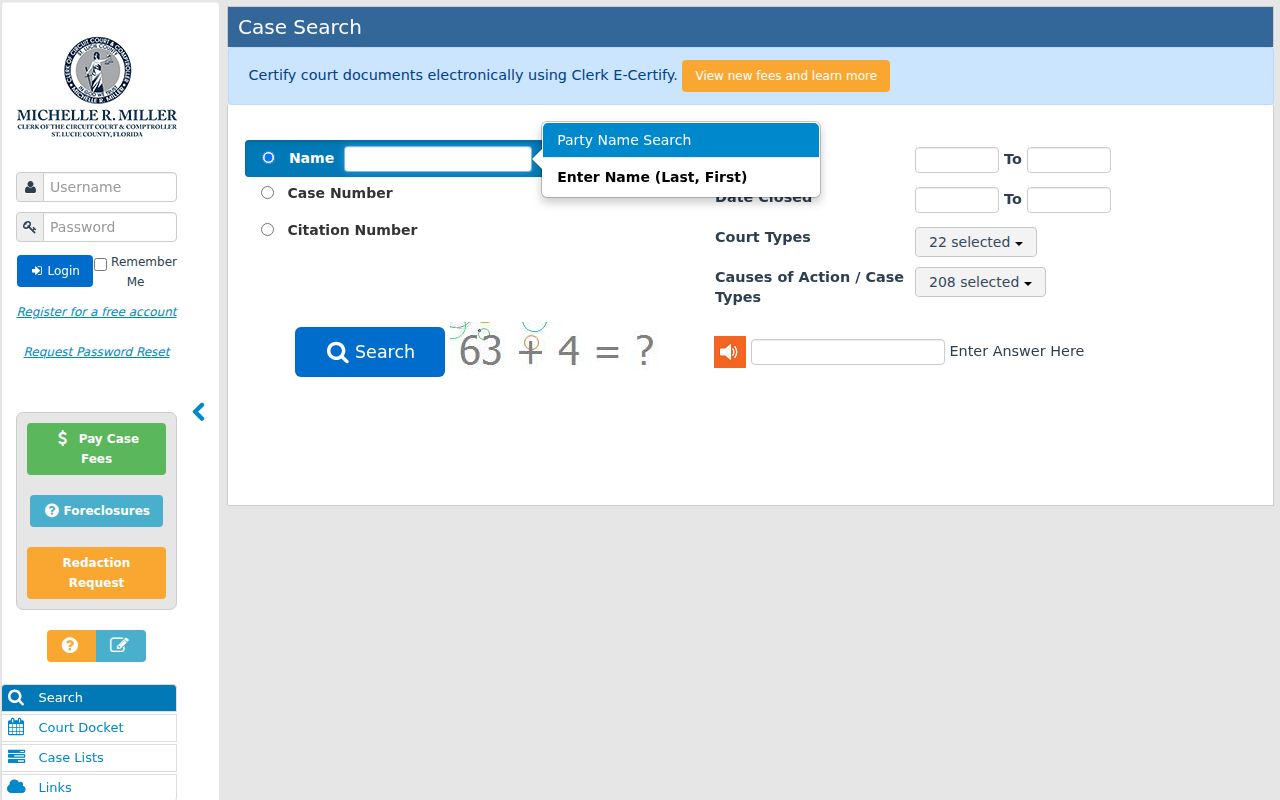
The many court-type filters help separate people who share a common name.
Florida Voter Directory Limits
Florida treats a number of voter-file fields as public, subject to exemptions. The public record can include name, address, date of birth, party, phone, and email. Social Security numbers, driver-license or state-ID numbers, and the source of an application are never released. A signature may be viewed but not copied. The controlling rule appears in Florida Statutes §97.0585, while the Attorney General's Address Confidentiality Program and other occupational exemptions protect qualifying people.
The St. Lucie County Supervisor of Elections provides the local voter-information route. Florida's Division of Elections also distributes a monthly active and inactive voter extract on disk rather than by email or public download. Neither route should be treated as proof that every adult at an address is registered or publicly visible.
Visit the county elections site to begin a personal registration lookup.
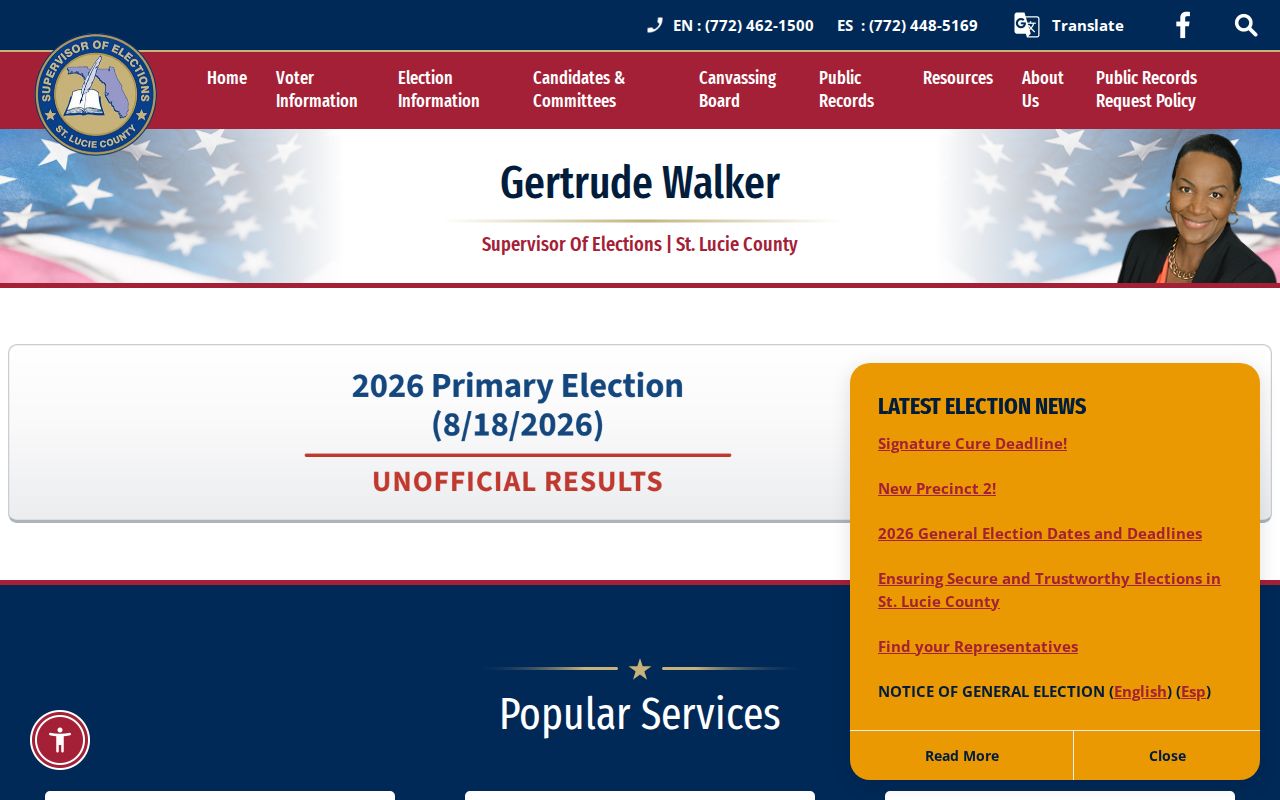
The official office is also the place to ask about exemptions or the correct voter-data request.
St. Lucie Vital Record Paths
Vital records require a different type of search. Florida's Bureau of Vital Statistics issues statewide birth, death, marriage, and dissolution certificates, while the Department of Health in St. Lucie County handles local birth and death certificates. The Clerk records local marriage licenses and divorce court files. A state marriage or dissolution certificate from June 6, 1927 forward is an abstract, not the complete local case file.
Eligibility depends on the record. Birth certificates are confidential under Florida Statutes §382.025 and are limited to the registrant at age 18, parents, guardians, legal representatives, and specified relatives after death. A birth record becomes public after 125 years under current guidance. Death records without cause are generally public, while cause of death stays confidential for 50 years and is restricted to eligible requesters.
Download the correct request from the Florida vital-record applications page.
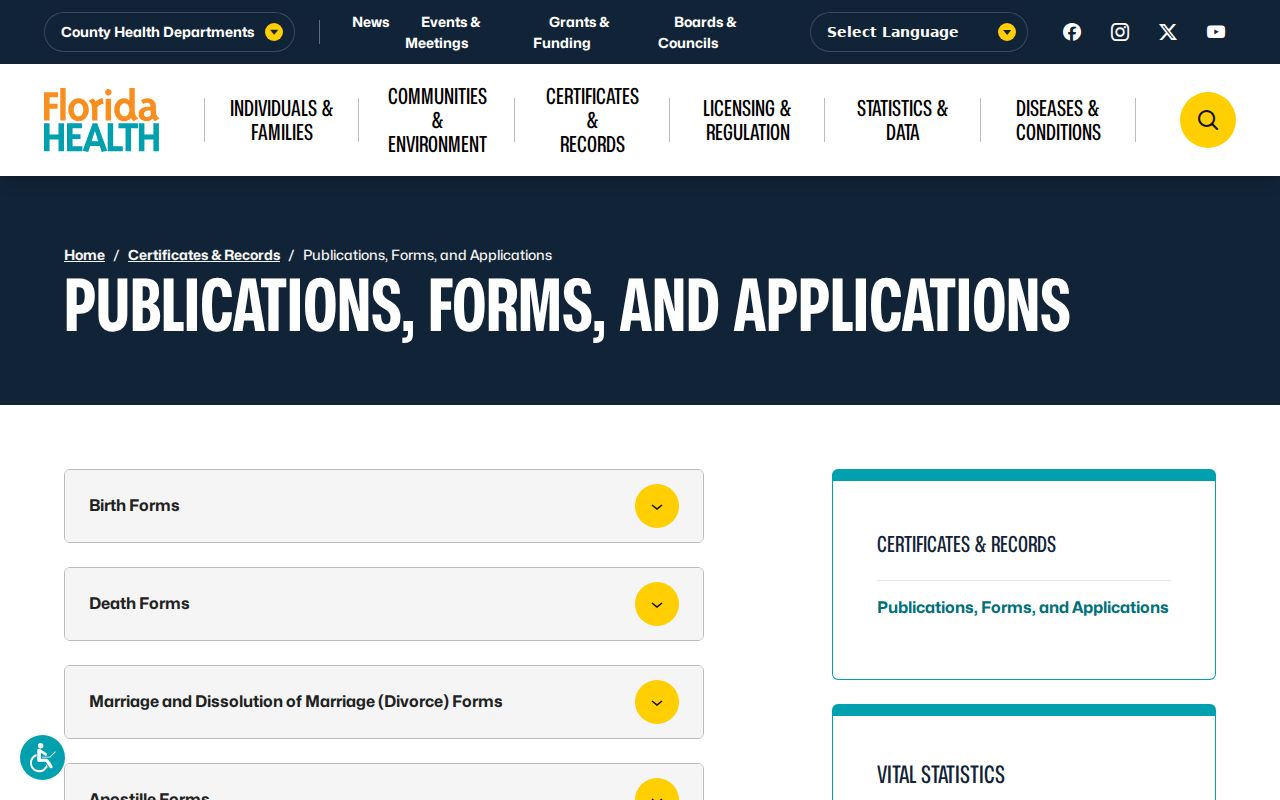
The form identifies the proof, eligibility, and ordering channel needed for that certificate.
Historic St. Lucie Resident Directories
Historical work shifts from current rolls to the St. Lucie County Library System, the Regional History Center, the State Library and Archives of Florida, Florida Memory, census schedules, newspapers, and FamilySearch catalog material. The State Library's city-directory collection spans the early 1900s to the present across Florida. Its catalog and reference staff can identify Fort Pierce and Port St. Lucie volumes that are not digitized.
A city directory entry may list a resident, spouse, occupation, employer, home address, and a notation for removal or death. Later reverse, or criss-cross, sections arrange entries by address. Pair each directory year with deeds or census material before concluding that the named person owned or occupied a parcel. The St. Lucie County city directory collection explains that historical shelf in full.
- Index
- A finding list that points to a record or image.
- Parcel
- A legally defined unit of land with its own identifier.
- Situs address
- The physical location of a parcel, which can differ from the owner's mail address.
- Criss-cross directory
- A directory section organized by street and house number instead of surname.
St. Lucie Deed Timeline Gaps
The Clerk divides recorded land history into meaningful date bands. Acclaim covers official records from 1980 forward. A separate Historical Deeds search is intended to expose deeds from 1905 through 1960, but the current Clerk navigation labels 1953 to 1960 as live and 1905 to 1953 as coming soon. Treat the earlier span as an active digitization question. Do not assume a missing online hit means no deed exists.
The 1960 to 1979 interval remains separately held. Ask Clerk Research for that band, and use earlier deed books or archive help when a chain crosses the online cutoff. A practical chain starts with the present owner and transfer citation on the parcel roll, then follows each seller back as a prior buyer while checking the same lot, block, and legal description.
Note: Coverage labels are changing, so confirm the live Historical Deeds range with the Clerk before relying on an online gap.
Municipal St. Lucie Address Records
Port St. Lucie's public property and permit search accepts house number, street, direction, section, block, and lot. A Property KEY opens permit history. Results may show both current-system and Legacy rows, so inspect both. A red address can flag a possible issue or violation, but it is not proof of wrongdoing or current ownership. The commercial project tracker adds project number, address, permits, review comments, approval milestones, and dated staff notes.
County Tyler EnerGov covers permitting, planning, code enforcement, and contractor licensing for county jurisdiction. Fort Pierce uses its own public-record and Enterprise Permitting routes. When an online portal fails, Port St. Lucie accepts public requests online and through in-person, email, postal, phone, and fax channels. Fort Pierce accepts a general request but is not required to create or reformat a record. St. Lucie County's own chapter 119 portal is the main route for county departments, with mail and email alternatives.
Official St. Lucie Directory Evidence
Official portals and commercial people-finding tools serve different roles. Government indexes expose records created for a defined public task and name the custodian. Commercial tools may combine old addresses and unverified material without showing why a detail appears. A resident search should favor the source closest to the fact, then preserve the record date and citation.
| Measure | Official St. Lucie source | Commercial category |
|---|---|---|
| Authority | Named public custodian | Private data compiler |
| Best use | Verify one defined record fact | Generate a lead that needs checking |
| Correction | Contact the office holding the roll | Use the provider's correction or opt-out process |
| Cost | Many indexes free; copies may cost | Pricing and access vary |
Florida Public Records Law begins with article I, section 24 of the state constitution and chapter 119. A request generally needs no special wording, purpose, or Florida residency. The custodian must respond in good faith within a reasonable time, not a fixed deadline. St. Lucie County's 2025 schedule treats more than one-half hour of staff work as extensive use that may be charged.
Checking St. Lucie Resident Findings
Finish a residents directory search by testing identity, place, and time. Compare full names and initials. Confirm the parcel or legal description rather than trusting a similar street address. Read the filing or effective date, and distinguish a physical address from a mail address. A court case should be checked through its disposition, because an allegation or arrest is not a conviction. A deed party may have sold long ago. A voter record can be exempt or stale.
Ask for a certified copy only when an official version is needed. Clerk fees list records searches at $2 per year, standard copies at $1 per page, and certification at $2 per document. Ordinary inspection under chapter 119 is generally free, while extensive labor and copies may be charged. If a county department holds the record, use the St. Lucie County public-record request route. If the Clerk holds it, use Clerk Research instead.
A careful St. Lucie County residents directory result states what the source proves and what it does not. That small habit prevents a historical address, business link, or namesake from becoming a false claim about a present resident.